recomBlot Borrelia canis IgG
recomBlot Borrelia canis IgM
Immunoblot test with antigens produced by recombinant techniques for the detection of IgG or IgM antibodies directed against Borrelia burgdorferi in dog
The bacterium Borrelia burgdorferi, a spirochete, is responsible for Lyme borreliosis. This disease is transmitted to dogs by ticks. Lyme borreliosis is a multisystemic disease with diverse manifestations which make clinical diagnosis difficult. Direct detection of the pathogen is also problematic. Therefore, in routine diagnosis, the serological detection of Borrelia-specific antibodies represents the easiest and safest method for the detection of a Borrelia infection.
Enzyme immunoassays or immunofluorescence tests are mainly used for screening. In comparison with the screening test, the recomBlot Borrelia canis tests exhibit additional criteria with regard to sensitivity and specificity. They allow the detection and identification of IgM and IgG antibodies and are used to confirm the results of the indirect immunofluorescence and enzyme immunoassays. The application of highly specific and immunodominant Borrelia proteins is made possible by the use of antigens produced by genetic engineering.
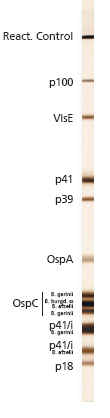
Therefore, the recomBlot Borrelia canis tests define a new standard in veterinary diagnosis. Only the recomBlot Borrelia canis detects antibodies against all three genospecies (Borrelia burgdorferi sensu stricto, Borrelia garinii und Borrelia afzelii) on one single teststrip:
- VlsE from different genospecies
- OspC from all genospecies and different B. garinii strains
Product advantages
- Recombinant antigens, therefore
- High sensitivity and specificity
- Easy and clear interpretation due to easy to read bands
- Optimum presentation without cross-reacting Borrelia proteins
- Immunodominant antigens of the three genospecies: B. burgdorferi sensu stricto, B. garinii and B. afzelii
- Easy test procedure; automation possible
- Easy and objective evaluation and documentation by recomScan software
- Test procedure and reagents identical in all MIKROGEN strip tests - reagents exchangeable
- Safe evaluation due to contol sera and kit specific control strip
- Separate detection of IgG and IgM antibodies
- Standardised serum-liquor-analysis available
- Complement as confirmation tests ideally the recomWell Borrelia tests (ELISA)
Testprinciple and procedure
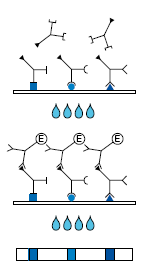 1st. Incubation
A test strip loaded with Borrelia antigens is incubated with diluted serum or plasma in a dish for 2 hours.
Wash 4 times
2nd. Incubation
Peroxidase conjugated anti-dog antibodies (IgG or IgM specific) are added. Incubate for 45 minutes.
Wash 4 times
3rd. Incubation
5 - 10 minutes after addition of the coloring solution, insoluble colored bands develop at the sites on the test strips occupied by antibodies.

Evaluation
Vaccination Study
Canine antibody generation against Borrelia burgdorferi prior and after the vaccination with Merilym (Company Merial)
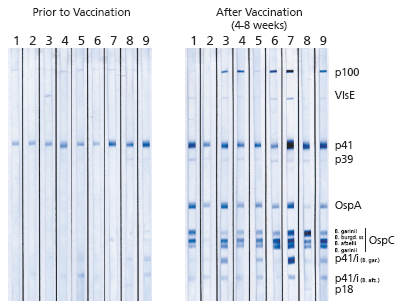
Nine dogs of different age and sex were vaccinated with Merilym. The first blood withdrawals and vaccinations were performed in March 2000, the second vaccinations four weeks later and the second blood withdrawals between four to eight weeks later. Sera of the dogs were tested for anti-Borrelia IgG antibodies using recomBlot Borrelia canis IgG.
Prior to the vaccination all dogs showed the generation of antibodies against p41 in recomBlot Borrelia canis IgG. In addition, weak band intensities below the cutoff were visible for p41i in the sera 5, 8 and 9, for p100 in the sera 1, 4, 5 and 7, and for VlsE in serum 3. After the second vaccination the dogs develop anti-Borrelia IgG-antibodies against all antigens on the blot strip in different intensities and patterns. Eight out of nine dogs showed an intensive OspA band after the second vaccination on recomBlot Borrelia canis IgG test strips (OspA is an important target for neutralising antibodies. Borrelia burgdorferi is already neutralized in the bowels of the tick through the host antibodies in the blood which was absorbed).
This study was performed by MedPharm GmbH in collaboration with Merial GmbH and Mikrogen GmbH.