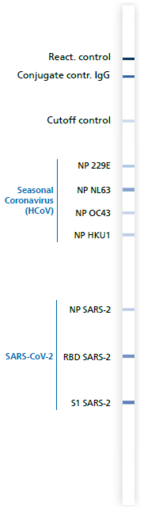
recomLine SARS-CoV-2 IgG [Avidität]
Recent findings to avidity of
SARS-CoV-2-specific antibodies and
studies
Line immunoassay with antigens produced by recombinant techniques for the detection of IgG antibodies against the coronavirus SARS-CoV-2 in human serum or plasma.
In contrast to most other virus infections, SARS-CoV-2 infections do not regularly lead to complete avidity maturation that would result in IgG of high avidity directed towards SARS-CoV-2 proteins. It rather has been found that avidity maturation after SARS-CoV-2 infections remains incomplete, and therefore stays at a low or intermediate level.
In a low percentage of cases with more severe COVID-19, requiring hospitalization, avidity maturation of IgG directed towards SARS-CoV-2 is more pronounced. On the other side, SARS-CoV-2 infections may impair the function of the germinal centers that are responsible for avidity maturation and thus prevent avidity maturation. This situation may result in extremely poor prognosis.
Specifically determined SARS-CoV-2-IgG points to SARS-CoV-2 infection, even in those cases in which PCR- and/or antigen testing no longer can detect preceding infections. Despite the diagnostic power of SARS-CoV-2 IgG determinations, the complexity of the serological response towards SARS-CoV-2 does not allow an easy and unequivocal determination of the time of infection through avidity measurement.
Two vaccination steps induce IgG of high avidity directed SARS-CoV-2 S1 and RBD in a high percentage of vaccinated individuals. An additional, third immunization step leads to a shift to high avidity in those individuals that only had reached low or intermediate avidity after two vaccination steps. This transition can be ensured by avidity determination in each individual case.
Previously SARS-CoV-2-infected individuals only require one vaccination step to establish IgG of high avidity. If additional enhancement of avidity is required, an additional vaccination step is appropriate.
Induction of IgG of high avidity directed towards SARS-CoV-2 S1/RBD is of eminent significance for protective humoral immunity. Therefore, specific avidity determination may become more important for the control of the present pandemic. It is of particular importance to ensure a high avidity status of elderly or immunocompromised individuals, as well as individuals that have a high risk of exposition to SARS-CoV-2. This can be achieved through specific avidity determination of SARS-CoV-2 IgG S1/RBD. When needed, additional vaccination steps are adviceable and their success can be easily controlled.
*summarized by Prof. Dr. G. Bauer, Freiburg, 02/2022. The complete report (only in German) can be accessed here.
The main findings on the avidity of IgG against SARS-CoV-2 were acquired with the recomLine SARS-CoV-2 IgG [Avidität] in combination with avidity reagent (art. no. 11010).
Literature
- Bauer G. (2021). The variability of the serological response to SARS-corona virus-2: Potential resolution of ambiguity through determination of avidity (functional affinity). Journal of medical virology, 93(1), 311–322. https://doi.org/10.1002/jmv.26262
- Bauer G. (2021). The potential significance of high avidity immunoglobulin G (IgG) for protective immunity towards SARS-CoV-2. International journal of infectious diseases : IJID : official publication of the International Society for Infectious Diseases, 106, 61–64. https://doi.org/10.1016/j.ijid.2021.01.061
- Bauer, G., Struck, F., Schreiner, P., Staschik, E., Soutschek, E., & Motz, M. (2021). The challenge of avidity determination in SARS-CoV-2 serology. Journal of medical virology, 93(5), 3092–3104. https://doi.org/10.1002/jmv.26863
- Struck, F., Schreiner, P., Staschik, E., Wochinz-Richter, K., Schulz, S., Soutschek, E., Motz, M., & Bauer, G. (2021). Vaccination versus infection with SARS-CoV-2: Establishment of a high avidity IgG response versus incomplete avidity maturation. Journal of medical virology, 93(12), 6765–6777. https://doi.org/10.1002/jmv.27270
- Struck, F., Schreiner, P., Staschik, E., Wochinz-Richter, K., Schulz, S., Soutschek, E., Motz, M., & Bauer, G. (2022). Incomplete IgG avidity maturation after seasonal coronavirus infections. Journal of medical virology, 94(1), 186–196. https://doi.org/10.1002/jmv.27291
- Bauer G. (2022) High avidity of vaccine-induced immunoglobulin G (IgG) against SARS-CoV-2: potential relevance for protective humoral immunity. Explor Immunol. 2022;2:133–156. https://doi.org/10.37349/ei.2022.00040)