recomWell Campylobacter IgG
recomWell Campylobacter IgA
Enzyme immunoassay with antigens produced by recombinant techniques for the detection of IgG and IgA antibodies against Campylobacter jejuni and Campylobacter coli
The genus Campylobacter comprises gram-negative, spiral-shaped, microaerophilic, mesophilic to thermophilic bacteria with bipolar flagella. Human Campylobacter infections are mainly food associated intestinal infections with world-wide incidence. Contaminated and insufficient cooked foods or drinking water in tropical countries are the main sources of infection. The pathogen reservoir is mainly the intestinal tract of warm-blooded wild, domestic and pet animals. Intestinal Campylobacter infections are the second most frequent enteric bacterial infections reported in Germany after enteric Salmonelloses, whereas unreported cases not reflected in the statistics probably outnumber reported cases many times over.
Campylobacter jejuni is much more frequent, accounting for over 90% of cases as compared to Campylobacter coli at approx. 9%. Besides nearly asymptomatic (clinically inapparent) courses, infected persons suffer from painful gastrointestinal symptoms with sometimes bloody diarrhoea, fever, meningism and myalgias. In rare cases sequelae like postinfectious Reactive Arthritis or Guillain-Barré-Syndrome may develop with onset a few weeks after the primary infection.
recomWell Campylobacter is a quantitative in vitro test for the detection and safe identification of IgG or IgA antibodies against specific antigens of Campylobacter jejuni and Campylobacter coli. In cases of previous or persistent Campylobacter infection with primary diagnosis based on stool sample culturing, recomWell Campylobacter, as a screening test, provides for identification of specific Campylobacter antibodies for the purpose of clarifying postinfection complications.
Product advantages
- Recombinant antigens, therefore
- High sensitivity and specificity
- Excellent discrimination between negative and positive results
- Immunodominant antigens of Campylobacter jejuni and Campylobacter coli
- Separate detection of IgG and IgA antibodies possible
- Identical procedure for IgG and IgA determination
- Easy to quantify
- Easy test procedure; automation possible
- Test procedure and reagents identical in all MIKROGEN ELISA - reagents exchangeable
- Break-a-parts: single simple examination possible
- CE label: The recomWell Campylobacter tests meet the high standard of the EC directive 98/79/EC on in vitro diagnostic medical devices.
Testprinciple and procedure
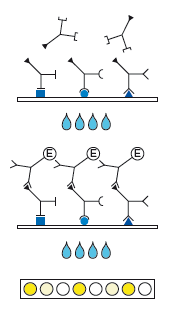 Indirect sandwich test.
Recombinant antigens are bound to the solid phase.
1st Incubation
Add patient samples diluted 1:101 (sample: 10 µl of serum or plasma), incubate for 1 h at 37 °C.
Wash 4 times
2nd Incubation
Add peroxidase conjugated anti-human IgG or IgM antibodies (conjugate), incubate for 30 min at 37 °C.
Wash 4 times
Color reaction
Add ready-to-use TMB solution and incubate for 30 min at room temperature. Stop the substrate reaction with H3PO4 and measure the extinction at 450 nm.
Evaluation
Patient samples from different sources were tested to assess the performance capability of recomWell Campylobacter.
Sensitivity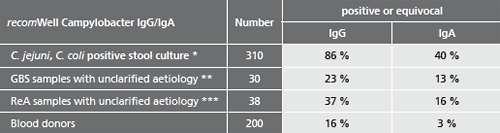
* Samples from patients with positive Campylobacter stool cultures (C. jejuni, C. coli). Blood samples were taken 0 to 81 days after the stool diagnostics, the beginning of the disease was unknown.
** Samples from patients with suspected Guillain-Barré-Syndrom (GBS) unclarified aetiology. No data on previous illnesses involving diarrhoea were known. (Testet with recomLine Campylobacter without P39).
*** Samples from patients with suspected Reactive Arthritis (ReA) unclarified aetiology. No data on previous illnesses involving diarrhoea were known.
Potentially falsifying sera of patients (n=100) infected by Yersinia enterocolitica/Y. pseudotuberculosis, Helicobacter pylori, Borrelia burgdorferi, Parvovirus B19 and Toxoplasma gondii did not show a higher number of increased Campylobacter antibody titers.